YouTube YPP Requirements 2027: What Changes on February 1
- 14 Sep, 2026
YouTube is making it harder for new channels to unlock ad and Premium revenue from February 1, 2027.
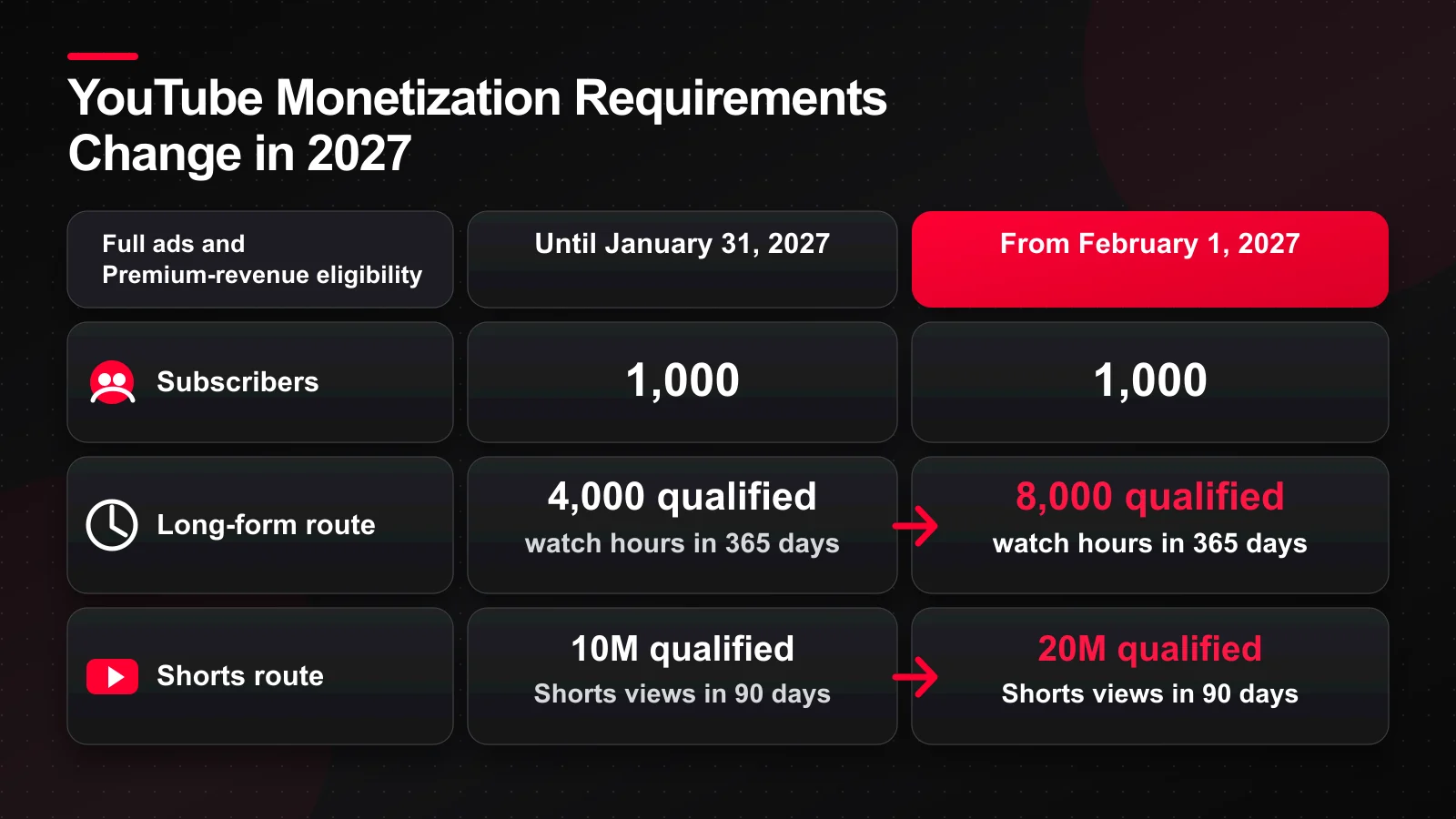
Starting February 1, 2027, a new creator will need 1,000 subscribers plus either 8,000 qualified watch hours in the last 365 days or 20 million qualified Shorts views in the last 90 days.
That is double the current 4,000-hour and 10-million-Shorts routes.
But the new-entry bar is not the only number that matters.
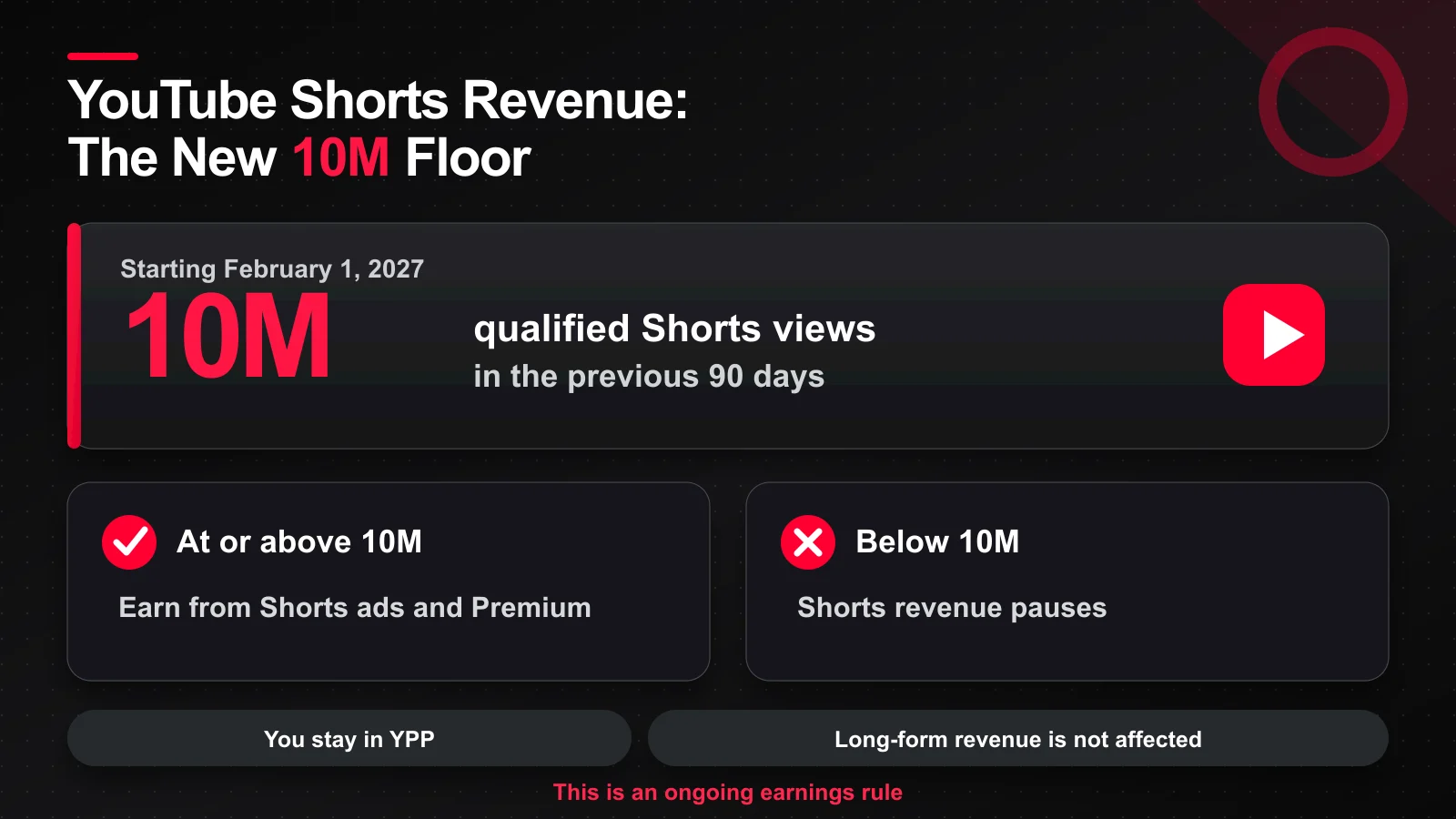
From the same date, every creator who wants to earn from the standard Shorts Creator Pool needs 10 million qualified Shorts views in the previous 90 days. That is a recurring earnings condition, not an entry condition. Fall below it and Shorts ad and subscription revenue pauses, while your YPP membership and eligible long-form revenue continue.
YouTube YPP requirements 2027 at a glance
Do not mix up the new-entry thresholds with the recurring Shorts earnings rule. The first visual shows the higher full-revenue bar for new applicants; the second shows the separate 10M rolling floor for Shorts earnings.
The scale is worth making concrete: 20 million qualified Shorts views in 90 days is about 222,000 views every day. The ongoing 10-million-view earnings floor is about 111,000 views every day. Neither is the same as one viral upload.
There is good news too: earlier access to fan funding, Shopping, and Creator Partnerships is not changing; Premium Lite is expanding; and YouTube is adding some new Shorts opportunities.
But let’s be clear about the headline: this is a tougher front door to ad revenue, especially for creators who are still proving that they can build a repeat audience.
Our view is that the change is bad for early-stage creators in the short term, but understandable for YouTube’s long-term business.
It is a blunt instrument. It will make life harder for original small channels alongside low-effort operations. Yet the real lesson is not to chase a threshold for its own sake. If you want YouTube to become a business, 4,000 or 8,000 watch hours is only the beginning. A sustainable channel needs far more watch time, returning viewers, and several ways to earn.
Here is exactly what is changing, which creators are affected, and the practical move to make before February.
The official YouTube announcement and YPP Help Center update are worth reading in full. The Help Center page has the most complete detail, including contract and activity requirements.
What is changing to YouTube YPP in 2027?
1. The ad-revenue threshold doubles for new creators
This is the change that matters most to channels that are not yet fully monetized.
New applicants still need 1,000 subscribers. From February 1, they also need either 8,000 qualified watch hours in 365 days or 20M qualified Shorts views in 90 days. The visual above compares those requirements with the current 4,000-hour and 10M-Shorts routes.
The key word is new. YouTube says that channels already in YPP do not lose their status because of this new entry rule.
If you are close to the current 1,000-subscriber and 4,000-hour threshold, do not treat February as a vague future date. Treat it as a real finish line.
Qualify and submit your application well before February 1. YouTube has not published a special transition rule for an application that was submitted under the current 4,000-hour threshold but is still under review on the cutover date.
2. Shorts revenue gets a rolling 10M-view gate
From February 1, creators need 10 million qualified Shorts views over the last 90 days to earn each month from the Shorts Creator Pool.
Miss the threshold and YouTube says you stay in YPP. Your long-form earnings and other YPP earnings are not affected. But your standard Shorts pool earnings pause until you cross the threshold again.
The visual above separates that 10M rolling earnings floor from YPP membership and long-form revenue, which continue when a channel falls below it.
This is a major change for channels that use Shorts as a light, occasional format. It turns Shorts ad revenue into something that requires sustained scale, not just a one-off viral month.
YouTube is pairing the change with optional Shorts incentive programs, such as Shopping bonuses, production credits for brand deals, and cultural-trend earnings boosts. It is also introducing a direct 45% revenue share for eligible targeted Shorts ads when an advertiser targets five or fewer channels. Those are useful additions, but they are not a replacement for reliable standard Shorts revenue on a smaller channel.
3. Premium Lite creates another subscription-revenue pool
YouTube is expanding Premium Lite to all countries where Premium is available.
This is a pool allocation, not a guaranteed 60% payout to an individual creator: 60% of Premium Lite net subscription revenue goes into its creator pool, compared with 30% of standard YouTube Premium net subscription revenue. The pool is distributed according to member watch time and views, after which the familiar 55% long-form and 45% Shorts revenue shares apply.
YouTube says creators earn more per user from Premium than from ads on average, based on its 2026 performance.
That is a positive change for long-form creators with a loyal audience. It is not a reason to expect a predictable payout increase on day one: your actual result will depend on where your viewers are and how Premium Lite adoption grows.
4. “Active” YPP channels get clearer rules
From February 1, a YPP channel is considered active if it meets one of these:
-
1,000 qualified watch hours in the past 365 days.
-
1 million qualified Shorts views in the last 90 days.
-
Two long-form uploads or five Shorts uploads every 90 days.
Creators who fall below the active threshold will have a 90-day window to restore status by meeting the watch-hour or Shorts-view requirement.
5. Updated contracts need attention too
To keep fully monetizing, review and accept the updated YPP terms in YouTube Studio by January 31, 2027.
Missing that date does not remove your channel from YPP, but it stops earnings from the affected monetization modules until you accept the terms. If you enabled fan funding before 2023, YouTube also says you may need to accept its current Commerce Product Module.
Who needs to act now?
Near 1,000 subscribers and 4,000 qualified watch hours
You can still use the current full-revenue threshold before February 1. Finish the current target and submit your application early.
In the 500-subscriber earlier-access tier
That tier remains, but it is not the full ads and Premium tier. Keep its fan-funding and Shopping access, while continuing toward 1,000 subscribers and the full-revenue requirements.
Already earning from long-form
The new 8,000-hour entry rule does not remove your YPP status. Accept the updated terms by January 31 and monitor the new activity rules.
Earning from or relying on Shorts
The 10M rolling qualified-view floor can pause standard Shorts pool revenue. Treat 10M views per 90 days as a recurring income threshold, not a one-off target.
Applying for full revenue close to the deadline
YouTube has not published cutover treatment for applications still in review. Do not wait: apply as soon as every step in the Earn tab is complete.
What counts toward YouTube YPP watch hours and Shorts views?
The long-form and Shorts routes are separate.
For the watch-hour route, YouTube counts qualified watch time from public long-form videos. Watch time from Shorts feed views does not count. Neither do private, unlisted, deleted, or ad-campaign views; livestream watch time only counts when the stream is public and remains available as video on demand.
For the Shorts route, YouTube counts qualified views from public Shorts that appear in the Shorts feed. Private, unlisted, deleted, paid-campaign, and image-post views do not count.
This is why Shorts should usually support your long-form strategy rather than replace it: Shorts can grow discovery and subscribers, but they do not build your long-form watch-hour total. For the rolling requirement, see our guide to when YouTube public watch hours refresh.
Creator reactions: frustration, pragmatism, and a shared worry about Shorts
The first wave of conversation has been split.
In r/PartneredYouTube, established and aspiring creators overwhelmingly focus on the new Shorts gate. One mixed-format YPP creator says their Shorts may generate around $100 from a million views in a good month, but they have never reached 10 million views in a 90-day period. Another says the change could make them stop publishing occasional Shorts because the new rule favors channels able to publish at huge volume. Others welcome that trade-off if it helps discourage low-effort, mass-produced content.
In r/NewTubers, the reaction is more personal: creators who were already working around jobs and life see an extra 4,000 watch hours as another year—or more—before their first ad payout. At the same time, some experienced voices make an important point: a creator planning to make a living from YouTube will ultimately need much more than 8,000 watch hours a year anyway.
YouTube’s Head of Editorial and Creator Liaison, René Ritchie, also stepped into that PartneredYouTube discussion to clarify the point causing the most confusion: missing the new 10-million-view Shorts threshold stops Shorts pool earnings, but does not remove a channel from YPP or stop long-form revenue.
On X, YouTube’s own @YouTubeCreators post summarizes the same three changes and frames them around a program that now serves more than three million creators and the need for a sustainable creator business.
These discussions are anecdotal, not a survey of the whole creator economy. But they reveal the real tension in the update:
-
The optimistic view: fewer channels seeking tiny Shorts payouts may reduce monetization-driven spam and leave more room for creators building genuine viewing habits.
-
The skeptical view: an indiscriminate threshold does not only filter low-value content. It also delays original educators, specialists, hobby channels, and creators in lower-RPM regions who are building carefully but steadily.
Both can be true.
Is this good or bad for creators?
Our take: bad policy design, useful strategic signal
Doubling entry thresholds without increasing the core long-form or standard Shorts revenue share is hard to call a win for new creators.
For a small original channel, the difference between 4,000 and 8,000 qualified watch hours is not just another number. It can be months of work before the first opportunity to earn ad or Premium revenue. The 20-million qualified Shorts-view route is even more demanding and makes casual Shorts monetization unrealistic for most creators. High-effort, lower-volume formats such as animation, research-led education, and documentary work can feel that delay most acutely.
We also do not think a higher number is a perfect cure for low-quality content. Mass-produced channels are built for volume. A thoughtful creator making fewer, better videos may feel the barrier more than the operation YouTube is trying to discourage.
But YouTube is not wrong about the bigger direction. It needs a healthy advertising environment, active creators, and a programme that can support more than three million partners over time. It has also been tightening enforcement against repetitive, inauthentic content. The likely business logic is to concentrate its programme on creators who can demonstrate sustained demand, while investing in incentives that are more targeted than tiny recurring payouts.
That is our inference, not YouTube’s stated reason. YouTube’s stated rationale is to reflect how viewers watch today and keep YouTube a sustainable, long-term growth engine for creators’ businesses.
The strategic signal is useful: YouTube is rewarding durable attention more than ever.
How to get into YPP before February 2027
1. Make the current YPP threshold a focused, time-bound goal
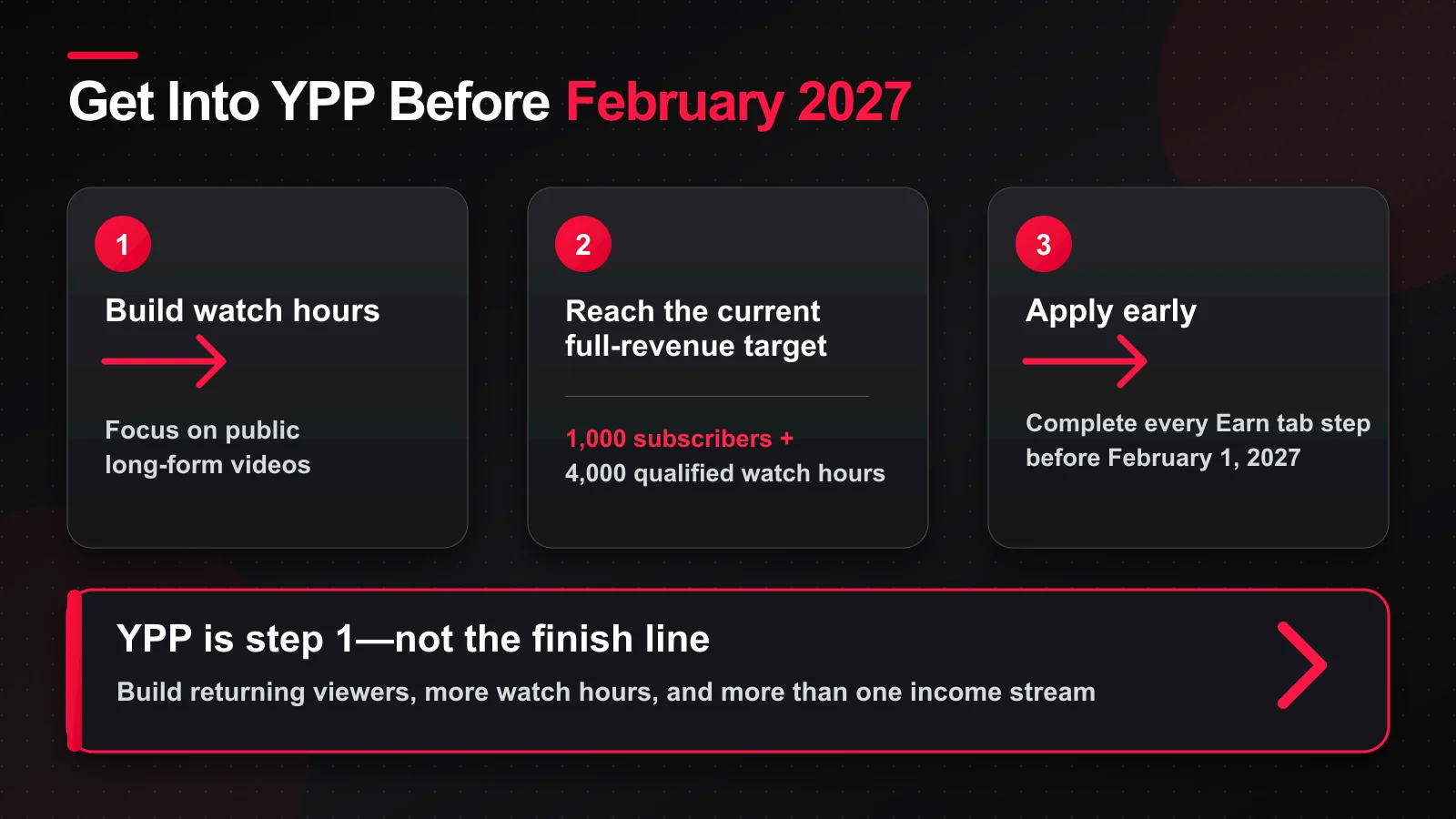
If you are within reach of 1,000 subscribers and 4,000 qualified public watch hours, focus on qualifying for the full ads-and-Premium tier before February 1, 2027.
Do not wait until the final week. Leave time to complete every Earn-tab step—terms, AdSense association, and review. YouTube says a standard review typically takes about a month, and can take longer when application volumes are high or a channel needs more than one review.
At publication on September 14, there are 139 days before February 1. Starting from zero, that means roughly 200 qualified watch hours every week just to reach 4,000 in time. Your own target should be based on the gap in Studio—not a generic number—because the 365-day counter rolls forward every day.
Use this simple formula:
Weekly watch-hour target = (4,000 − your current qualified watch hours + a safety buffer) ÷ weeks remaining before your application date
Add a buffer for older watch hours that may fall out of the rolling 365-day window before you apply.
If your current trajectory reaches 4,000 after February 1, stop planning against the old target. Your practical target is 8,000 hours, unless you change the pace before the deadline.
2. Choose the long-form route unless Shorts are already your proven engine
For most channels, long-form is the more controllable path to 4,000 watch hours.
Build videos around problems, questions, stories, and topics that viewers are willing to spend time with. Make connected videos so a viewer who enjoys one has an obvious next video to watch. Turn a good topic into a useful series rather than treating every upload as a separate lottery ticket.
Shorts can still be excellent for discovery and subscribers. Use them to introduce a clear promise, then direct interested viewers to a relevant long-form video. Do not assume a few viral Shorts will turn into meaningful Shorts revenue—especially after the new rules start.
3. Improve the metrics that create watch hours, not just views
Watch hours come from a simple relationship:
Watch hours = views × average view duration ÷ 60
That gives you two levers: earn more qualified views and keep the right viewers watching longer.
For every upload, review:
-
Whether the title and thumbnail attract the specific viewer the video is made for.
-
Whether the first 30 seconds quickly deliver on that promise.
-
Where viewers leave and whether the video earns the next click through an end screen, playlist, or natural verbal handoff.
-
Which topics bring viewers back for another video instead of only producing a temporary spike.
This is the same work that helps you get monetized now and earn more once you are.
4. Treat YPP as step one, not the business model
Getting into YPP is an achievement. It is not a salary.
At the entry threshold, ad revenue is usually modest and varies widely by audience, geography, topic, season, and video format. A channel with 4,000 or 8,000 watch hours has proved there is demand; it has not yet proved that the demand is large enough to fund a business.
Your real goal should be much bigger than the threshold:
-
More watch hours every month, not one qualifying 365-day total.
-
A growing base of returning viewers.
-
Videos with enough depth and relevance to earn higher-quality viewing time.
-
Revenue that is not dependent on a single spike or one monetization feature.
That is why the best response to this update is not to panic-publish. It is to build a channel that people genuinely choose to watch again.
5. Track the runway, not just the finish line
You cannot manage a rolling requirement by checking it once a month.
Creatipi will remain the go-to iOS app for creators who want a clear view of monetization progress. Use it to keep an eye on your watch-time runway, subscriber growth, revenue signals, and the videos that are actually moving your channel forward.
The requirements may change. The useful question remains the same: is your channel building more qualified viewing time this month than last month?
YouTube YPP 2027 FAQs
Will I lose YPP if I do not reach 8,000 watch hours in 2027?
No. YouTube says the new 8,000-hour and 20-million-Shorts-view thresholds apply to new creators entering YPP for ads and Premium revenue. Existing YPP status is not affected by that update.
If I am already monetized, do I still need 10M Shorts views?
Only to earn from the standard Shorts Creator Pool each month. If you miss 10 million qualified Shorts views in the last 90 days, you remain in YPP and your long-form and other YPP earnings are not affected. Shorts pool earnings resume if you cross the threshold again.
Is the 500-subscriber YPP route going away?
No. In eligible countries, the early-access tier remains at 500 subscribers, three valid public uploads in 90 days, and either 3,000 qualified watch hours in a year or 3 million qualified Shorts views in 90 days. It provides earlier access to eligible fan funding, Shopping, and Creator Partnerships; it is not the same as full ad and Premium revenue sharing.
If I am already in the 500-subscriber tier, am I protected from the new 8,000-hour rule?
Do not assume so. YouTube says the 500-subscriber tier remains unchanged, but its announcement describes the 8,000-hour requirement as the threshold for new creators applying for ads and Premium revenue sharing. YouTube has not published specific transition guidance for earlier-access members moving to the full-revenue tier. If full ad revenue matters to you, work toward the current 1,000-subscriber and 4,000-hour requirement and submit before the deadline.
What if I meet the current threshold, apply, and my watch hours fall while I wait for review?
YouTube says that once your channel has met the required count and has been sent for review, a later drop in subscribers or watch hours does not normally stop the review. Changing a video’s privacy or deleting it can still affect the application. This does not answer the separate February cutover question, so applying early remains the safer plan.
Should I stop making Shorts?
No. Make Shorts when they serve your audience or help the right viewers discover your longer videos. Just do not build a business plan around small, inconsistent Shorts pool payouts. After February 2027, standard Shorts revenue is clearly aimed at channels with sustained large-scale Shorts viewership.
What should I do this week?
Open the Earn tab in YouTube Studio.
Write down your current qualified watch hours, qualified Shorts views, subscribers, and the date your oldest strong watch-hour period will start dropping from the rolling window.
Then choose one growth path for the remaining runway: a coherent long-form series for watch hours, or a Shorts strategy only if your channel already has credible momentum toward the current 10-million-view route.
The bottom line
The 2027 YPP update makes the first ad-revenue milestone harder. That is disappointing for creators who are close, and it is especially tough for original Shorts-first creators without massive scale.
Still, the deadline gives you a clear window: build toward the current 1,000-subscriber and 4,000-watch-hour threshold now, then complete your application with enough time for review before February 1, 2027.
Then keep going.
The real prize is not unlocking the monetization switch. It is building enough consistent watch time that YouTube becomes a resilient business rather than a channel waiting for one payout.
Creatipi is here to help you see that progress clearly, from your first qualifying watch hour to the much bigger milestones that come after it.
Sources and further reading

Ed (Creator of Creatipi)
YouTuber since 2018 • Built Creatipi to help creators track growth, beat algorithms, and earn more.
Pro tip: I use Creatipi daily to grow my own channel. These strategies? Tested on real videos — not theory.